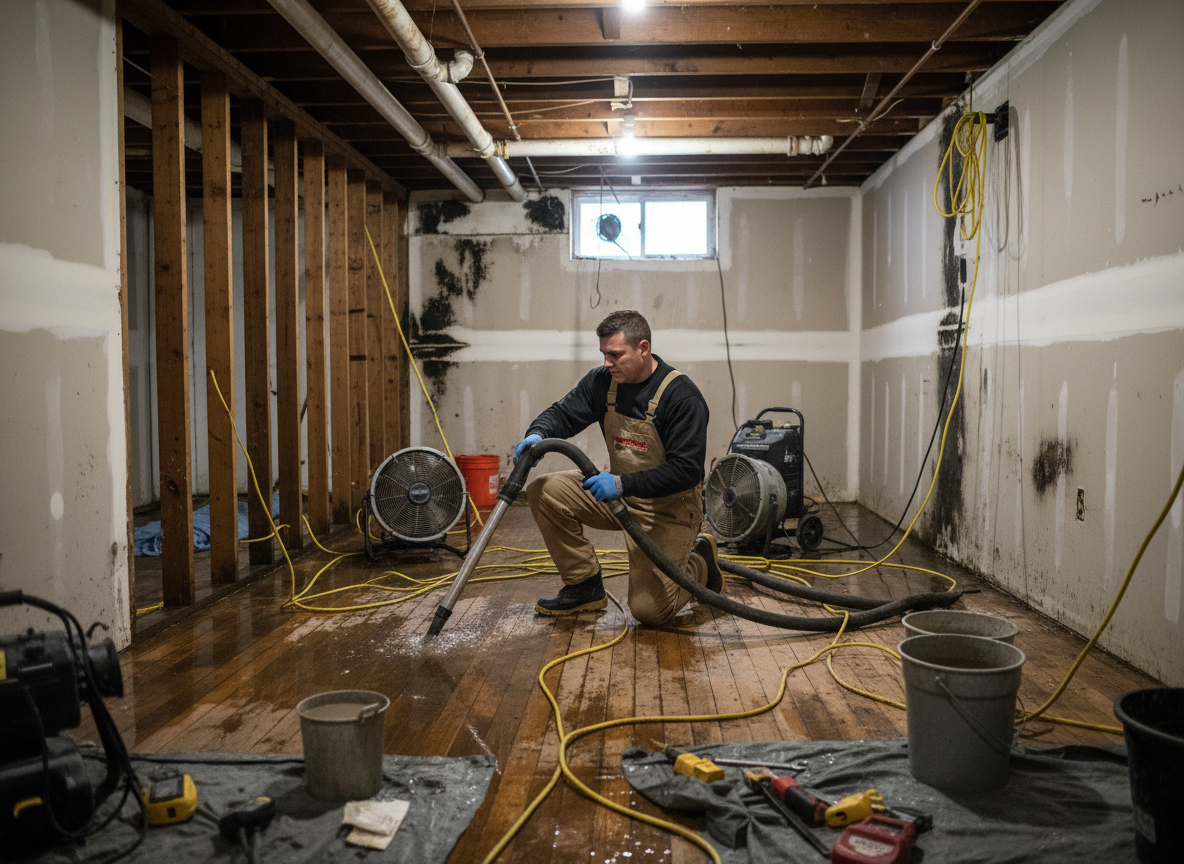
Cresskill sits right on the Yonkers side of the Westchester-Bergen line, with many 1920s to 1960s colonials and split-levels built on sloped lots that drain toward Tenakill Brook. When a supply line bursts or a summer storm backs water into a basement, the clay-heavy soil and tight side yards make extraction and drying slower than in flatter parts of town. Our crew at 73 Market Street rolls out with truck-mounted equipment that fits the narrow driveways common here.
Winter freezes followed by sudden thaws hit Cresskill hard because many homes still have galvanized or early copper lines running through unheated crawl spaces. We see the same pattern every January: a call from a homeowner on Madison Avenue or near Merritt Memorial School after a pipe splits overnight. Quick response keeps the damage from traveling into finished lower levels or shared walls with the house next door.
Because Cresskill borders Hastings-on-Hudson and the Bronx, traffic on the Saw Mill River Parkway can delay equipment coming from farther north. We stage extra dehumidifiers at our Yonkers shop so we can reach Cresskill streets within the hour even during rush periods.
Around 33. Cresskill
We regularly work near:
- 📍Tenakill Brook
- 📍Cresskill High School
- 📍Merritt Memorial Elementary School
- 📍Madison Avenue
- 📍Cresskill Public Library
Water Damage Restoration in 33. Cresskill — Local Notes
- •Narrow driveways and steep side yards off Palisades Avenue limit equipment size, so we often use portable extractors first.
- •Clay soil around Tenakill Brook holds water longer, requiring extended drying times after basement seepage.
- •Many 1950s splits have finished lower levels with limited access points, making moisture mapping essential before removal begins.
- •Cold snaps send water from burst pipes under slabs on streets like Grant Avenue, where we pull baseboards to reach hidden saturation.